
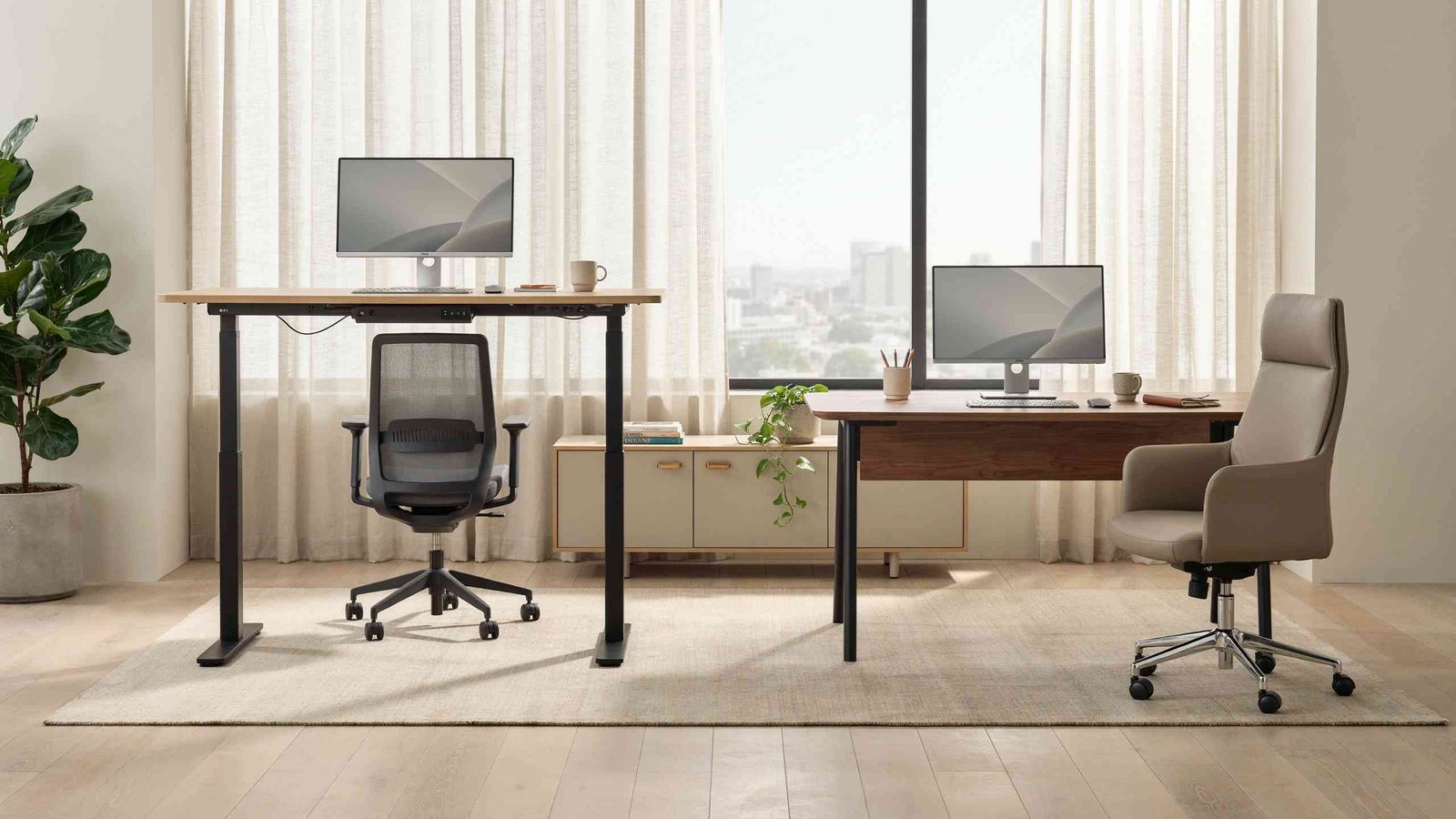
The desk you choose for your office affects how comfortably your team works through the day, shaping posture, focus, and how much flexibility your workstations offer. A height-adjustable desk lets you shift between sitting and standing, while a fixed desk holds a single set height throughout the workday, each suited to a different way of working.
Neither option suits every office equally. Your decision usually depends on how your team works, the space you have, your budget, and how much flexibility your employees need. This guide covers the factors that matter most when choosing between the two for your office.
What Are Height-Adjustable and Fixed Desks?
A height-adjustable desk can be adjusted both up and down to allow for sitting and standing, either by hand or by an electric motor. You’ll usually find height-adjustable desks in hot-desking areas, individual workstations, and departments where employees spend long periods sitting.
A fixed desk remains at a set height and typically uses a simple, stationary frame. Fixed desks are typically found in reception areas, meeting rooms, and standard cabins, where the type of work carried out does not require changing positions.
Read more: Smart Desks for IT Offices: Boosting Productivity Through Ergonomic Design
Height-Adjustable Desks vs Fixed Desks: Key Differences
Eight practical factors separate the two options, and each one affects how your workstation feels to use every day, not just how it looks in a brochure.
Flexibility and Adjustability
Flexibility is about how easily you can change your working position during the day. Switching from sitting to standing takes seconds on a height-adjustable desk, while a fixed desk keeps you in one position for the full shift. Departments with long, varied tasks tend to value that adjustability more than areas with short, routine work.
Employee Comfort
Comfort depends on how well the desk height matches the person using it. Each employee can set their working height on an adjustable desk, which matters when your team includes people of different builds. A fixed desk can also fit well if you have an adjustable chair and select the right desk height.
Productivity and Focus
How you use a desk matters more than which type you choose. Some days call for more movement, whether that means standing during a call or changing position while reviewing documents, and a height-adjustable desk makes that easier. Other tasks need you to settle in and stay focused, which is where a fixed desk works well. We would not say one desk makes you more productive than the other. The real difference is the flexibility each one gives you while you work.
Space and Office Layout
The layout of the space will be determined by the size of your desk and floor plan. Adjustable desks require careful planning, especially in smaller areas, as you need sufficient clearance for movement and proper cable routing. Fixed desks can work well in smaller layouts and cabins where the workstation does not need to be repositioned or adjusted.
Durability and Maintenance
Maintenance requirements can vary depending on the number of moving parts in each desk. A fixed desk is easy to maintain, requiring only periodic cleaning, and has a simple frame. While adjustable desks have moving parts, like electric motors or manual lifting mechanisms, they might require periodic adjustments or maintenance over time.
Cost and Investment
Cost is usually the first thing you consider when making a decision. Fixed desks are also an affordable option for large-scale deployments on a budget. While adjustable desks may have a higher initial cost, the investment can be worthwhile if employees are likely to use the height adjustment regularly.
Aesthetics and Office Design
The aesthetics are important when your desk has a look that matches your home. Both desk types are available in finishes suited to modern office interiors. Adjustable desks can also add a contemporary look through features such as visible frames and integrated control panels. Fixed desks are generally easier to incorporate into conventional office layouts.
Team and Department Requirements
Each team has its own kind of work according to the needs of the department. If your design, engineering, or IT workers spend long hours at their desktops, they may appreciate the flexibility to shift positions during the day. Reception staff and short-duration workstations manage well with fixed desks.
Which Desk Is Better for Your Office?
There’s no universal best desk, only the one that fits how your team actually works. Depending on how much flexibility you need, what your budget allows, and how consistent you want things across departments and locations, you’ll likely fall into one of three situations.
- Height-adjustable desks suit you when flexibility matters, and each employee needs control over their own working position. Long hours at a single desk, hot-desking, and shared workstations all benefit from that adjustability.
- Fixed desks work well when simplicity, consistency, and a controlled budget matter more than individual adjustment. Reception areas, short-duration workstations, and large-scale rollouts where uniformity is the priority tend to suit fixed setups.
- A combination of both suits offices where requirements differ by department, with flexible desks in areas where flexibility is beneficial and fixed desks in areas where it is not.
Consider your job category, hours worked, available space, employee count, and growth plans in advance. A customised workstation solution can help you manage these without requiring you to adopt a single desk type across your office.
Read more: Office Furniture for Startups: What to Prioritize When Setting Up a New Workspace
Why Choose Customised Office Desks?
Customised office desks let you match your workstation design to your exact space, team size, and department needs instead of settling for a fixed catalogue option. We build each workstation around how your office is actually used, with durable materials and functional detailing suited to everyday demands.
You can also combine desk configurations across departments, mixing adjustable and fixed setups in the same office, along with storage, a meeting room, a cafeteria, and collaborative furniture that keeps your workspace consistent. That flexibility supports a professional look while giving you room to adapt as your team grows.
Conclusion
Comparing height-adjustable desks vs. fixed desks doesn’t really give you a single winner; it gives you options that suit different offices. What works for your team depends on your hours, your space, your budget, and honestly, where you see things heading. At Benchy, we build both customised office desks and workstations for offices across Kerala and Bangalore, and we’re happy to help you figure out what actually fits.


[…] Learn more about: Height-Adjustable Desks vs Fixed Desks: Which Is Better for Your Office? […]