
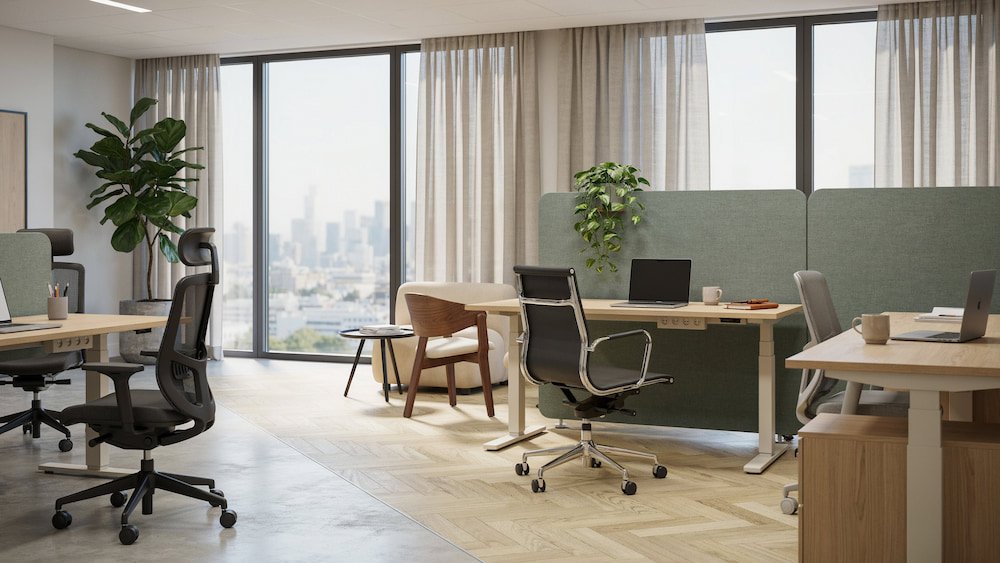
An office chair is one of the most frequently used pieces of furniture in any workplace. Employees may spend several hours in the same chair each day, so comfort, support and adjustability should be considered before making a purchase. The right chair can make a desk feel more comfortable, while a poorly chosen one can become a source of discomfort during long working hours.
Not every employee needs the same type of seating. A designer working at a computer, a manager attending meetings, a receptionist welcoming visitors and a team using a training room all have different requirements. This guide explores the main types of office chairs, their features and suitable applications to help businesses choose seating that works for their workspace.
Why the Right Office Chair Matters
A good office chair can make a noticeable difference to the way people feel during a working day. When the seat height, backrest and lumbar support are appropriate, employees can maintain a more natural sitting position instead of constantly shifting to get comfortable.
This matters particularly in computer-based jobs where people remain at their desks for several hours. Better support can help reduce the discomfort and tiredness that often comes with prolonged sitting. It can also make it easier for employees to stay focused on their work rather than being distracted by an uncomfortable seat.
There is also a visual aspect. Well-chosen office seating gives a workspace a more organised and professional appearance. For business owners, it is therefore worth looking at chairs as both a workplace necessity and a long-term investment.
Ergonomic Chairs
Ergonomic chairs are intended for employees who spend a large part of their day sitting at a workstation. Instead of offering a fixed seating position, they usually provide several adjustments so the user can set the chair to suit their body and desk.
Depending on the model, features may include adjustable lumbar support, seat height, armrests, seat depth and backrest recline. A well-fitted ergonomic chair should allow the employee to sit comfortably while keeping the feet supported and the back properly positioned.
These chairs are particularly suitable for IT teams, designers, accountants, administrators and other employees who work at a computer for long periods. For businesses focused on everyday employee comfort, ergonomic office chairs are often one of the most useful seating investments.
Task Chairs
Task chairs are straightforward, practical and widely used for everyday office work. They are generally designed to fit standard workstations without taking up excessive space.
Most task chairs have a wheeled base, a height-adjustable seat and a supportive backrest. Some models include armrests or a reclining mechanism, while simpler versions keep the design more basic.
They work well in offices where many employees need similar seating for routine desk work. Their relatively compact design also makes them a sensible option when a business needs to furnish several workstations within a limited budget.
Executive Chairs
Executive chairs tend to have a larger frame, a higher backrest and more cushioning than standard task chairs. They are commonly found in manager cabins, directors’ offices and other spaces where a more substantial style of seating is appropriate.
Apart from comfort, appearance is an important part of an executive chair. Leather or leather-look finishes, padded armrests and broad backrests can give a cabin a more formal character.
However, a large chair is not automatically a better chair. Businesses should still check whether the model provides adequate back support and useful adjustments before choosing it.
Mesh Office Chairs
Mesh seating has become a familiar sight in contemporary offices, particularly in warmer regions. The main attraction is the breathable backrest, which allows air to circulate rather than trapping heat against the user’s back.
Mesh chairs are available in both simple task-chair designs and feature-rich ergonomic models. They are well suited to open-plan offices, computer workstations and spaces where employees spend long periods seated.
Conference and Meeting Room Chairs
Meeting rooms have different seating requirements from individual workstations. People may spend anywhere from a few minutes to several hours in meetings, so the chairs need to provide reasonable comfort without the extensive adjustment features of an ergonomic workstation chair.
Conference chairs usually have a clean, professional design and may feature padded seats and backs. Lightweight models are useful when a meeting room needs to be rearranged for presentations, workshops or larger gatherings.
The best choice should also complement the conference table and the overall interior rather than looking like an unrelated addition.
Visitor Chairs
Visitor chairs are commonly placed in reception areas, cabins and client meeting spaces. Unlike workstation chairs, they are generally fixed in design and do not require wheels or multiple adjustments.
Since visitors may only use them for a short period, the focus is usually on basic comfort, durability and appearance. The material should also be easy to maintain, especially in busy reception areas.
A well-designed visitor chair can complete a reception space without making it feel overly formal or crowded.
Training Room Chairs
Training rooms need furniture that can be moved around easily. A session may require rows of chairs, small groups or an open area for activities, so heavy fixed seating can become inconvenient.
Training chairs are often lightweight and compact. Some models include writing tablets, while stackable designs make storage much easier when the room is being used for another purpose.
For companies that regularly conduct employee training, workshops or seminars, choosing practical training chairs can save both floor space and setup time.
Cafeteria and Breakout Area Chairs
Cafeterias and breakout zones are meant to feel less formal than regular work areas. Businesses can use simple dining chairs, stools, lounge seating or a mix of styles depending on the purpose of the space.
Durability and easy cleaning are important here. Furniture in these areas is exposed to food, drinks and frequent movement, so surfaces that are easy to maintain are preferable.
In breakout areas, the emphasis can shift towards comfort and a relaxed appearance, creating a place where employees can have informal conversations or take a short break from their desks.
Height-Adjustable and Sit-Stand Chairs
Sit-stand workstations have created a need for seating that works with higher desk positions. Height-adjustable stools and chairs allow users to take some weight off their feet while working at a raised surface.
They can be useful at reception counters, collaborative workstations and sit-stand desks. These chairs are not necessarily a replacement for a conventional office chair, but they can give employees another way to work comfortably during the day.
How to Choose the Right Office Chair
Start by looking at the actual work being done. Someone who sits at a computer throughout the day needs more support and adjustability than someone who uses a chair for occasional meetings.
Pay attention to lumbar support, seat height, armrest adjustment and the overall shape of the backrest. The chair should work comfortably with the height of the desk rather than being considered separately.
Material is another practical consideration. Mesh offers better airflow, while upholstered seating may provide a softer feel. Wheels and swivel mechanisms are useful for workstation chairs but may not be necessary for meeting or visitor seating.
Finally, look beyond the initial price. A chair that costs less but needs frequent replacement may prove more expensive over time. Build quality, warranty, maintenance and expected usage should all form part of the decision.
Why Choose Customised Office Chairs?
Not every office follows a standard layout. Some businesses have compact work areas, specialised departments or interiors that require furniture with a particular look. Customised seating can help address these requirements more effectively than choosing entirely off-the-shelf options.
Businesses can select finishes and designs that fit their interiors while maintaining consistency across different departments. Custom solutions can also be planned alongside workstations, storage and other furniture instead of treating seating as a separate purchase.
For companies furnishing an entire office, this approach can make it easier to create a workplace where comfort and visual consistency go together.
Read more: Office Furniture Essentials for Co-Working Spaces
Creating a Better Workplace with the Right Seating
The right office chair depends on more than appearance. Employees need different levels of support depending on their work, while reception areas, meeting rooms, training spaces and cafeterias each have their own requirements.
Benchy is a leading customised office furniture manufacturer in Kerala and Bangalore, offering ergonomic, executive, task, visitor and meeting room chairs. With an emphasis on quality craftsmanship, durable materials and practical design, Benchy also provides complete office furniture solutions, including workstations, storage, cafeteria furniture and collaborative furniture. Explore our seating and furniture solutions to create an office that is comfortable, functional and built for everyday use.


