
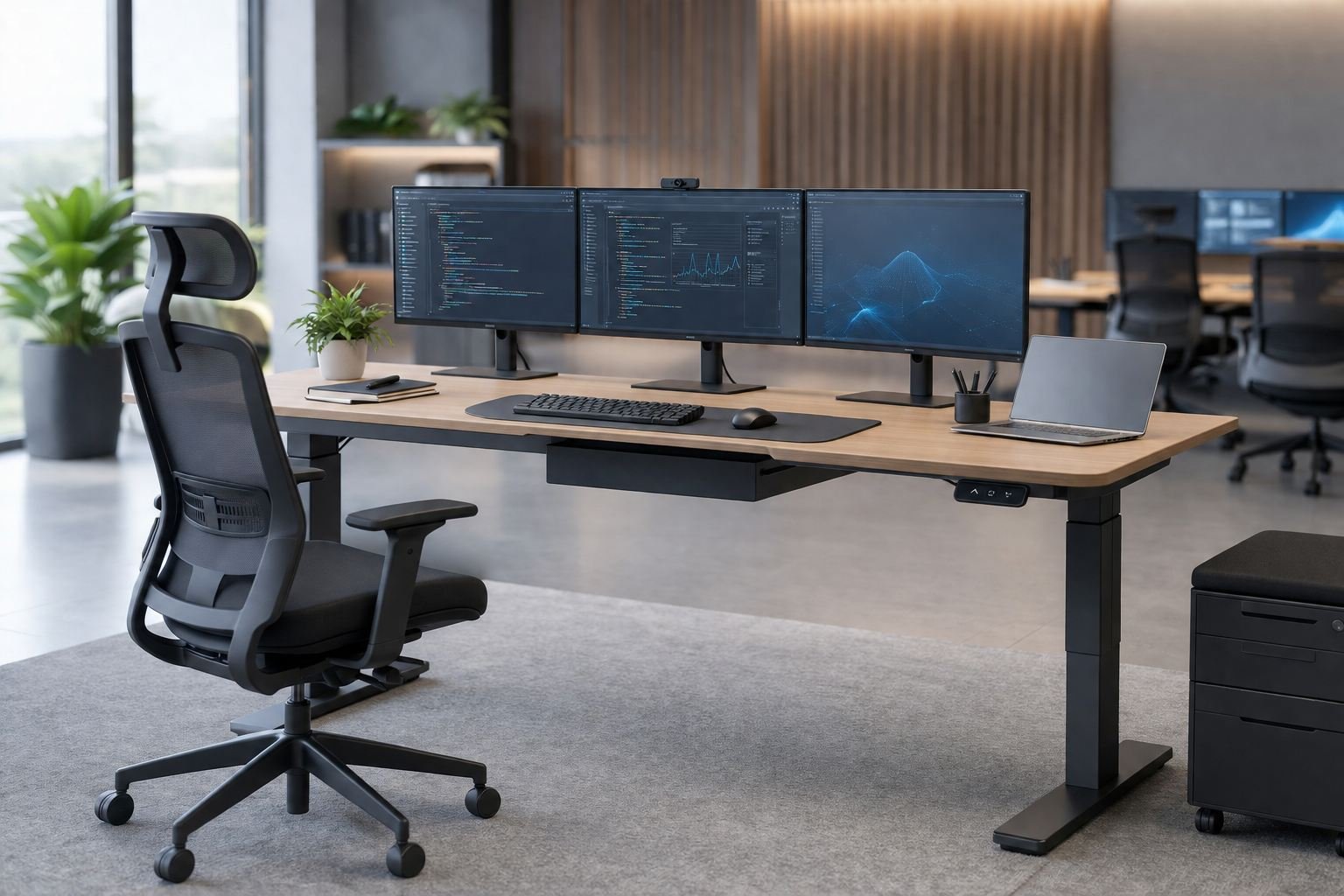
Walk into most IT offices and you’ll see the same thing: rows of people hunched over keyboards, eyes locked on screens, barely moving for hours at a stretch. Software engineers, system admins, data analysts, they all live at their desks. And yet, oddly enough, most IT firms never really stop to ask whether that desk is actually built for the job.
Standard office furniture wasn’t designed with this kind of screen-heavy, hardware-heavy work in mind. That’s the real reason an ergonomic smart desk setup makes sense for software teams. It’s not just about comfort, though comfort matters too. It’s an investment that shows up later in how much your people actually get done.
Why Do IT Offices Have Unique Furniture Needs?
An IT office just doesn’t run like a standard admin office. Engineers rarely work off one screen. Most days involve two or three monitors, a testing tablet on the side, a CPU tower taking up floor or desk space, and a tangle of cables and peripherals connecting all of it.
Developers also tend to work in long, uninterrupted focus blocks. So when a desk is too shallow to place monitors at a proper distance, or hardware ends up crammed right where the keyboard should go, posture suffers. Most generic desks simply weren’t built to carry that kind of load or handle that kind of layout, and over time it wears people down and breaks up their workflow.
The Link Between Productivity and Ergonomics
Discomfort has a way of quietly eating into output. Lower back stiffness, a stiff neck, sore wrists, none of it seems serious at first, but focus starts slipping the moment the body starts complaining. Research on repetitive strain injuries and chronic musculoskeletal issues backs this up: more micro-breaks, more distractions, and yes, more coding errors.
Height-adjustable desks help break that cycle. Being able to switch between sitting and standing keeps blood flowing and energy levels steadier through the day. People who work at ergonomic setups tend to report clearer thinking and more consistent output, partly because they can shift posture without losing their train of thought. It’s a small thing that adds up, especially by mid-afternoon when focus usually starts to dip.
Key Features of a Smart, Ergonomic IT Desk
A handful of features separate a proper IT desk from an ordinary office desk.
Height adjustment that actually works smoothly. A good sit-stand mechanism lets employees set the desk to their own body, not the other way around. Over months and years, that difference helps prevent spinal compression.
Cable and power management that keeps up. IT setups come with a lot of wiring. Built-in cable trays and accessible power points keep that mess contained and cut down on trip hazards.
Enough depth and legroom to actually move. A deeper desktop keeps multiple monitors at a safe distance from the eyes, and open space underneath means legs aren’t fighting for room all day.
Surfaces built to take a beating. Anti-glare, scratch-resistant, heavy-duty finishes hold up under constant hardware placement and daily wear in a way standard laminate just doesn’t.
A layout that can change when the team does. Modular desks let facilities teams reconfigure a floor quickly as engineering pods grow or projects shift direction, without tearing everything out and starting over.
The Manufacturer Advantage: Customization for IT Workspaces
Once you know what your team actually needs, the next question is simple: where do you buy it? Off-the-shelf furniture from a reseller or retail store rarely hits the exact specifications an IT floor calls for.
Going straight to a manufacturer changes that. You get to specify dimensions, finishes, and layouts that actually match your building’s blueprints, instead of adjusting your space to fit whatever furniture happens to be in stock.
Maybe that means angled desks for a QA lab, or custom cut-outs where power distribution is dense. Whatever the case, working directly with a manufacturer means the final product fits how your team actually works, not a generic template. It usually comes with faster turnaround and steadier quality control too, which matters a lot on bigger build-outs.
Beyond the Desk: Building a Complete Ergonomic Workstation
A well-designed desk is the foundation of an ergonomic workspace, but it is only one part of the solution. True workplace comfort comes from a combination of an ergonomic desk, a supportive chair, and properly positioned monitors working together. When these elements are thoughtfully integrated, they help reduce physical strain, support employee well-being, and create an environment that encourages deeper focus and sustained productivity.
Investing in the physical well-being of your engineering team delivers long-term benefits, including higher employee morale, improved retention, and consistently better work quality.
For companies looking to upgrade their office infrastructure, Benchy manufactures high-quality, tailor-made corporate furniture designed for modern IT and technical workspaces. We work closely with businesses to create functional, ergonomic environments that inspire creativity, enhance productivity, and support long-term business growth. Explore Benchy’s complete range of office furniture solutions to transform your workspace or discuss customized solutions for large-scale commercial projects.


[…] Read more: Smart Desks for IT Offices: Boosting Productivity Through Ergonomic Design […]
[…] Read more: Smart Desks for IT Offices: Boosting Productivity Through Ergonomic Design […]