
Today, India’s flexible workspace sector is no longer limited to freelancers and early-stage startups. According to JLL, flexible workspace operators leased 18 million sq. ft. of office space in 2025, accounting for 21.5% of India’s total office leasing during the year. This growing demand reflects a broader shift towards shared, managed, and flexible office environments among businesses of different sizes.
For co-working operators, this growth creates a practical design challenge: one space may need to support focused individual work, team discussions, client meetings, video calls, networking, and breaks throughout the day. In order to make these various activities function within the same floor plan, furniture is essential.
A well-planned co-working space therefore needs more than rows of desks. Modular workstations can adapt to evolve seating needs, ergonomic chairs accommodate longer work periods, and meeting tables, lounge seating, lockers, reception furniture and breakout tables serve specific purposes. The right choice of furniture can also help make better use of the available space while providing the workplace with a cohesive professional look.
So, what furniture does a co-working space actually need? Let’s look at the essential furniture pieces and how each one contributes to a functional and comfortable shared workspace.
Importance of Furniture in Co-Working Spaces
Furniture plays an important role in determining how people interact within a co-working space. A desk in a shared workstation is not the same as a table in a meeting room or a sofa in a breakout area. Giving each area the right furniture helps operators create distinct zones without necessarily adding walls or permanent partitions.
The choice also affects how much usable space a co-working facility can offer. Modular furniture can accommodate different seating arrangements, while appropriately sized tables and chairs can maintain comfortable movement between work areas. At the same time, durable materials become important when the same furniture is used by different members every day.
For members, these details influence their overall experience. A comfortable chair can make a full working day easier, while accessible storage, suitable meeting spaces and informal seating give users more ways to work according to their needs.
Essential Office Furniture for Co-Working Spaces
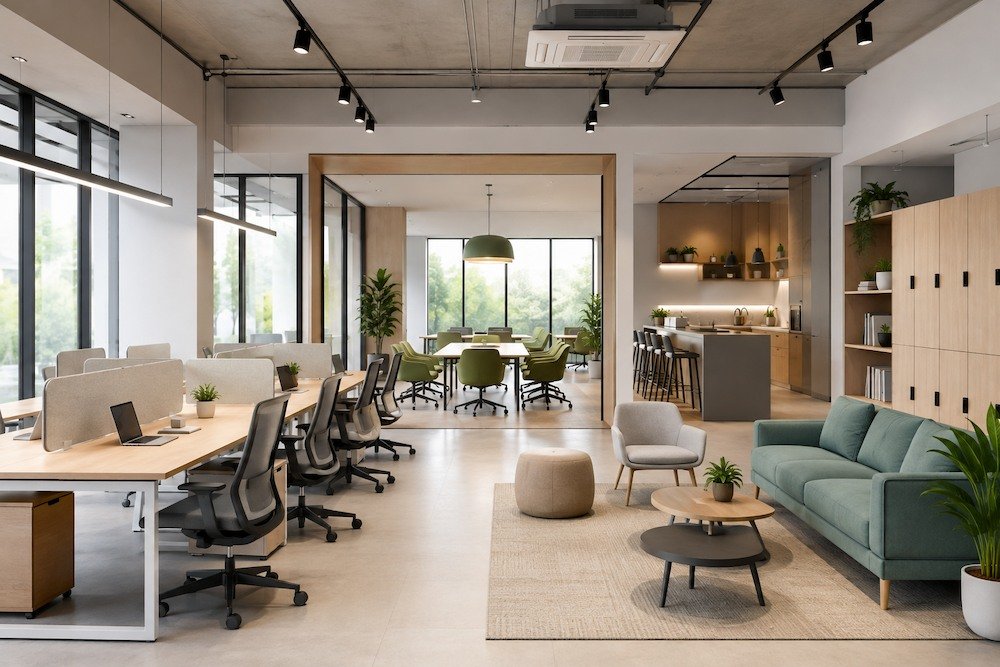
A co-working space typically combines several work zones, each serving a different purpose. Instead of using the same furniture throughout the facility, operators can choose furniture based on how each area will be used. The following are some of the key furniture essentials to consider when planning a modern co-working space:
- Modular Workstation Tables: The use of modular workstation desks is suited for various applications, such as hot-desking and team seating, as it comes with various configurations and styles, such as individual, cluster, and bench types, based on the requirements of the workplace.
- Ergonomic Office Chairs: co-working chairs are designed to cater to the needs of users with different preferences. Co-working chairs that come with features, such as adjustable lumbar support, arms, seat depth, and height, will function to suit a larger user base.
- Meeting & Conference Tables: The meeting table should be appropriate for the size and style of each meeting room. Use of small meeting tables is ideal for short conversations and meetings, while the larger conference room tables will suit a variety of uses, such as client conferences, presentations and discussions.
- Collaborative Seating and Lounge Furniture: The informal seating such as sofas, lounge chairs, and ottomans can form places for collaboration and casual interaction. They are also an alternative to offices because they bring variations to an office space.
- Reception Desk & Waiting Area Furniture: The reception area is a crucial part of the overall client experience and it has to be furnished in a functional way yet visually appealing. Correctly designed reception desks including comfortable chairs and tables placed nearby can deliver a good first impression without occupying much space.
- Furniture for Cafeterias and Breakout Areas: Both dining halls and break areas can be used as informal workspaces and places to eat. Depending on the size of the area different options like dining tables, coffee tables, benches, and bar stools are available.
- Storage Cabinets and Lockers: Lockers give members a convenient place to keep laptops, bags, documents, and other personal belongings, particularly when the workspace operates on a hot-desk model. Storage cabinets can accommodate office supplies, files, equipment, and shared resources.
- Phone Booths and Privacy Pods: Phone booths and privacy pods provide dedicated spaces for calls, virtual meetings, and conversations that require greater privacy. They are particularly useful in open-plan co-working spaces where permanent private rooms may not be practical.
- Height-Adjustable Desks: Height-adjustable desks offer users the option to alternate between sitting and standing while working. They can be introduced as a premium feature in dedicated work areas or offered as part of higher-tier co-working memberships.
Also Read: Top Office Design Trends for 2025: How Benchy is Ahead of the Curve
Factors to Consider Before Choosing Co-Working Furniture
Selecting the furniture for the co-working environment is not merely an aesthetic exercise. The furniture must be designed to accommodate multiple users at any time and also to fulfill the functionality requirements of the facility. There are many factors to think about:
- Ergonomics and comfort: Choose desks and chairs that accommodate different users and support extended periods of work.
- Space utilization: Consider floor area, circulation, seating capacity, and the distance between different work zones before selecting furniture sizes.
- Flexibility: Modular desks and movable furniture can make future layout changes easier.
- Durability: Shared furniture experiences regular use, so materials, finishes, hardware, and construction quality matter.
- Maintenance: Easy-to-clean surfaces and replaceable components can be practical for busy co-working facilities.
- Aesthetics and branding: Furniture colours, finishes, and forms should complement the visual identity of the co-working brand.
- Future requirements: Consider whether additional workstations, storage, or meeting areas may be required as occupancy grows.
- Long-term value: Compare the purchase price with expected lifespan, maintenance requirements, usability, and replacement costs.
Why Choose Customized Office Furniture?
It is not always a good idea to use the standard pieces of office furniture for a co-working space with a specific layout or for an office floor with an irregular shape. Customized furniture can be created according to specifications such as office size, the number of office workers and circulation of people, among others.
This also enables all the furniture pieces to have a unified design language throughout the area. Reception desks, workstations, conference tables, storage units and break areas can feature matching colours and materials.
For people creating multiple zones or thinking about possible building expansion, custom-made furniture can give them more control over the whole workspace and storage options while also contributing to making the space look more unified.
Custom Office Furniture for Co-Working Spaces at Benchy
The right combination of workstations, ergonomic seating, meeting furniture, storage, breakout areas, and privacy solutions can support different working styles within the same facility.
As the leading customized office furniture manufacturer in Kerala and Bangalore, Benchy offers a range of workspace furniture. Our collection ranges from workstation tables, ergonomic chairs, cafeteria furniture, meeting room furniture, reception furniture and storage solutions. With a focus on quality, craftsmanship, functionality, and modern workspace design, Benchy helps businesses create practical and flexible office environments.


